
The SIE Exam is a good starting point for people who want to learn about the U.S. securities industry. SIE stands for Securities Industry Essentials. The exam covers basic ideas about financial markets, investment products, trading, rules, and risks.
If you are new to finance, the SIE Exam may seem hard at first. But a simple study plan can make it easier.
This SIE Exam Study Guide explains what to study, how to prepare, and how to use your study time wisely.
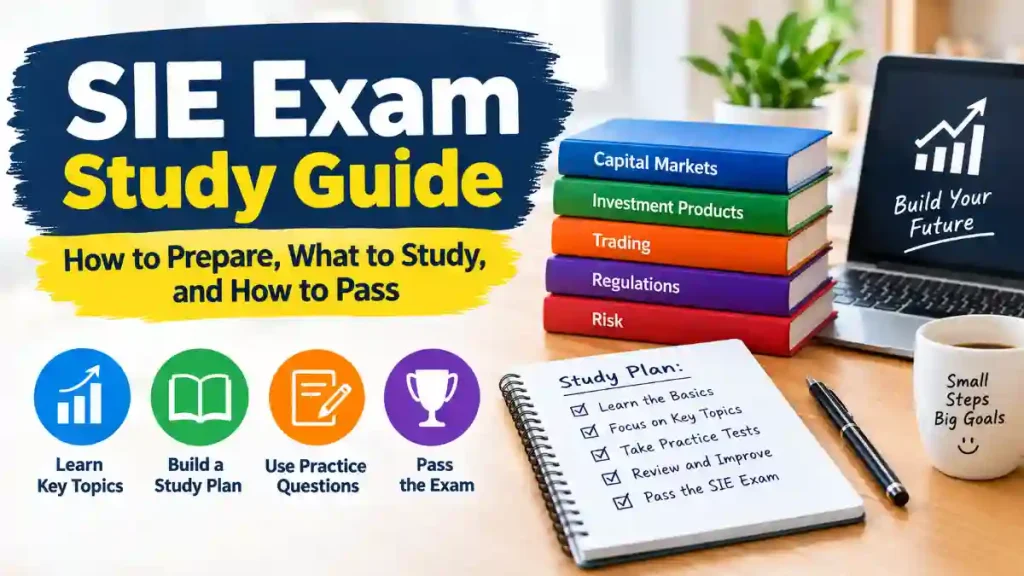
What Is the SIE Exam?
The SIE Exam is a FINRA exam that tests basic knowledge of the securities industry.
You do not need to work for a financial company to take the exam. However, passing the SIE Exam alone does not qualify you for every securities job. Some jobs also require a separate qualification exam and other requirements.
The best way to prepare is to learn the main topics and practice answering questions.
What Topics Are on the SIE Exam Study Guide?
Your study plan should cover the main areas tested on the exam.
| Study Area | What to Learn |
| Capital Markets | Markets, investors, and basic economics |
| Investment Products | Stocks, bonds, funds, and options |
| Trading | Orders and basic transactions |
| Regulations | Rules and financial organizations |
| Risk | Common types of investment risk |
Capital Markets
Start by learning how financial markets work.
Important ideas include:
- Primary and secondary markets
- Investors
- Issuers
- Broker-dealers
- Market makers
- Regulators
- Basic economic factors
- Interest rates
- Inflation
Try to understand each idea rather than just memorizing definitions.
For example, a company may issue new securities in the primary market as part of the SIE Exam Study Guide topics. Existing securities are then traded by investors on the secondary market.
Investment Products
You should know the basic features of common investment products.
Study:
- Common stocks
- Preferred stocks
- Corporate bonds
- Government securities
- Municipal securities
- Mutual funds
- Exchange-traded funds
- Options
For each product, learn what it is, how it works, and what risks may be involved.
Trading and Transactions
The SIE Exam also includes basic trading concepts.
Learn terms such as:
- Market order
- Limit order
- Stop order
- Bid
- Ask
- Spread
- Long position
- Short position
- Settlement
For example, a market order is generally used when an investor wants an order executed quickly at the best available price, a common topic in the SIE Exam Study Guide. A limit order sets a price condition for the trade.

Regulations and Financial Organizations
You should also understand the basic roles of important financial organizations.
These include:
- FINRA
- SEC
- Federal Reserve
- MSRB
- SIPC
- FDIC
Do not try to memorize long explanations. Focus on the main purpose of each organization.
Investment Risk
Risk is another important part of SIE Exam preparation.
Learn about:
- Market risk
- Interest-rate risk
- Credit risk
- Inflation risk
- Liquidity risk
- Business risk
- Reinvestment risk
Simple examples can make these topics easier to remember.
How to Make an SIE Exam Study Plan
Having a well-thought-out study strategy keeps you organised.
You can divide your preparation into four simple steps.
Step 1: Learn the Basics
Start with financial markets and basic terms.
Learn:
- How markets work
- Who participates in markets
- Basic investment products
- Major regulators
Do not worry if everything does not make sense on your first day.
Step 2: Study Investment Products
Next, focus on stocks, bonds, funds, and other products.
Make short notes for each product.
A simple format is:
Product → What it is → How it works → Main risks
This can make review easier.
Step 3: Practice Questions
After learning a topic, answer practice questions.
Practice questions help you find areas that need more study.
When you get an answer wrong, ask:
Why was my answer wrong?
Then review that topic before moving on.
Step 4: Review Your Weak Areas
Do not spend all your time studying topics you already know.
Make a list of difficult topics and review them often.
This can help you use your study time better.
Best SIE Exam Preparation Tips
Study a Little Every Day
Long study sessions are not always necessary.
Even a short daily session can help you stay familiar with the material.
Make an effort to study at the same time every day.
Use Simple Notes
Write short notes instead of copying large sections of a book.
Focus on:
- Definitions
- Important differences
- Rules
- Risks
- Investment products
- Trading terms
Use Active Recall
After studying a topic, close your notes and explain it in your own words.
For example:
Question: What is a stock?
Simple answer: A stock represents ownership in a company — a basic concept covered in this SIE Exam Study Guide.
This method can help you check what you really understand.
Practice Similar Questions
Some exam questions may use similar terms.
Practice helps you learn how to read the question and identify the important details.
Don’t just verify that your response was correct. Examine the rationale for the right response.
Common SIE Exam Study Mistakes
Avoid these common mistakes during your preparation.
Studying Without a Plan
Jumping from one topic to another can make studying confusing.
Create a simple schedule and follow it.
Only Memorizing Definitions
Memorization can help, but understanding is more useful.
Try to understand how different financial concepts work together.
Ignoring Practice Questions
Reading alone may not prepare you for exam-style questions.
Use practice questions to test your knowledge.
Not Reviewing Wrong Answers
Wrong answers show you where you need more work.
Keep track of difficult topics and review them again.
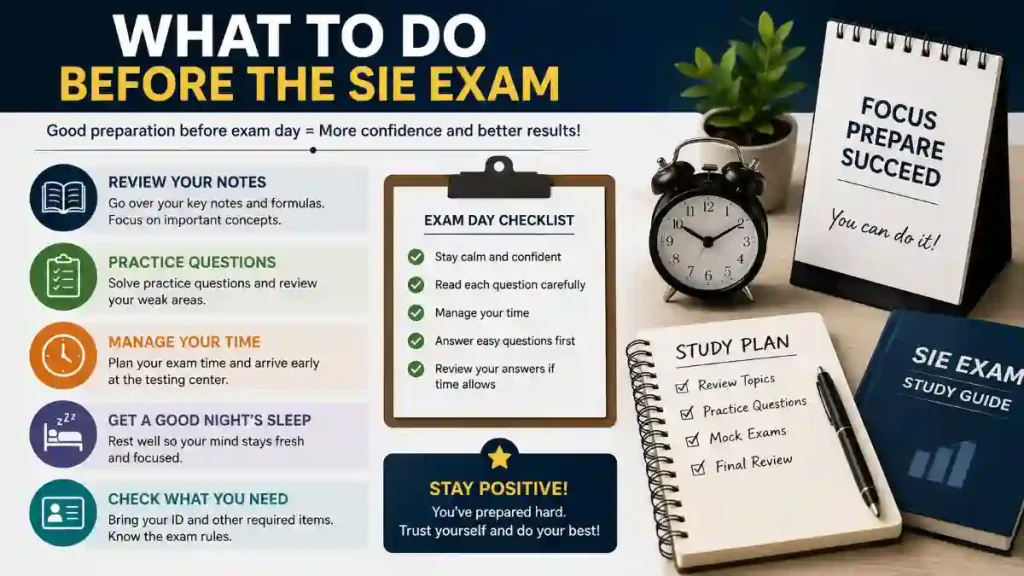
What to Do Before the SIE Exam
Before your exam, review the main topics instead of trying to learn everything at the last minute.
Make sure you understand:
- Capital markets
- Investment products
- Trading
- Regulations
- Investment risks
- Basic financial terms
Also, read each question carefully during the exam.
Watch for words such as not, except, or most likely. These words can change the meaning of a question.
If a question is difficult, do not panic a key tip in this SIE Exam Study Guide. Eliminate answers that are clearly wrong and then choose the best answer based on what you studied.
How to Improve Your Chances of Passing the SIE Exam
No shortcut can replace preparation.
A simple approach is:
- Learn the main topics.
- Make short study notes.
- Practice questions regularly.
- Review mistakes.
- Focus on weak areas.
- Review important concepts before exam day.
The goal is to understand the material, not simply memorize a list of answers.
Conclusion
This SIE Exam Study Guide becomes easier to manage when you have a clear study plan. Start with the basics, learn the main investment products, understand trading and regulations, and study common investment risks.
Use practice questions to test your knowledge and review every mistake. Keep your notes simple and study regularly.
Most importantly, use current and reliable study material — as recommended in this SIE Exam Study Guide — when preparing for the exam. Check official FINRA information for the latest exam details and requirements.
With organized preparation and regular practice, you can approach the SIE Exam with more confidence.
FAQs
What is the SIE Exam?
This SIE Exam Study Guide covers the SIE Exam, or Securities Industry Essentials Exam, which tests basic knowledge of the securities industry, including markets, products, trading, regulations, and risks.
What should I study for the SIE Exam?
Focus on capital markets, investment products, trading, regulations, customer-related topics, prohibited activities, and investment risks.
How should I prepare for the SIE Exam?
Create a simple study plan, learn the main topics, make short notes, practice questions, and review the areas where you make mistakes.
Is the SIE Exam difficult for beginners?
It can feel difficult if you are new to finance. Learning basic terms first and studying a little each day can make the material easier to understand.
Can I pass the SIE Exam with self-study?
Self-study can be part of your preparation using this SIE Exam Study Guide. Use reliable study material, follow the current exam content, practice questions, and review topics you do not understand.
