

Hey, I want to share something that happened to me recently about the SAT Math practice test.
I was chatting with a friend when I suddenly saw this term pop up, and honestly, I had no clue where to start.
I kept wondering, “Am I missing something here?” It felt a bit confusing, and I didn’t want to waste time studying the wrong way. So, I decided to look into the SAT Math practice test and figure out how it actually works.
After understanding it, I realized how important it is to practice with real, solved questions to avoid feeling lost on test day.
I handled it by learning the right steps and solving practice questions confidently, and now I feel ready whenever I sit down for SAT Math practice — no more confusion, just clear steps.
Why Should You Practice SAT Math?
The SAT Math test checks three big skills:
- Algebra – solving for x, working with equations
- Data and Numbers – percents, ratios, and reading tables
- Advanced Math – quadratic equations and functions
When you practice with real questions, you get better at:
- Knowing what SAT questions look like
- Solving problems faster
- Finding out what topics you need to study more
- Feeling more sure of yourself on test day
SAT Math Practice Test: Solved Questions
Here are sample SAT Math questions. Each one is solved step by step, so you can follow along.
H2: Algebra Questions
Question 1 If 3x + 7 = 22, what is x?
Solution Step 1: Take away 7 from both sides. 3x = 15 Step 2: Divide both sides by 3. x = 5
Answer: x = 5
Question 2 A taxi ride costs $3 to start. Then it costs $2 for every mile. The total cost is $17. How many miles was the ride?
Solution Step 1: Let m stand for miles. The equation is 3 + 2m = 17 Step 2: Take away 3 from both sides. 2m = 14 Step 3: Divide both sides by 2. m = 7
Answer: 7 miles
H2: Data and Numbers Questions
Question 3 A class has 30 students. 18 of them are girls. What percent of the class is boys?
Solution Step 1: Find the number of boys. 30 − 18 = 12 Step 2: Turn this into a percent. (12 ÷ 30) × 100 = 40
Answer: 40% of the class is boys
Question 4 This table shows how many books students read in a month.
| Books Read | Number of Students |
| 1 | 4 |
| 2 | 6 |
| 3 | 8 |
| 4 | 2 |
What is the average number of books read?
Solution Step 1: Multiply each number of books by the number of students, then add them up. (1×4) + (2×6) + (3×8) + (4×2) = 4 + 12 + 24 + 8 = 48 Step 2: Add up all the students. 4 + 6 + 8 + 2 = 20 Step 3: Divide the total books by the total students. 48 ÷ 20 = 2.4
Answer: 2.4 books
H2: Advanced Math Questions
Question 5 Solve for x: x² − 5x + 6 = 0
Solution Step 1: Break the equation into two parts. (x − 2)(x − 3) = 0 Step 2: Set each part equal to zero. x = 2 or x = 3
Answer: x = 2 or x = 3
Question 6 If f(x) = 2x² − 3x + 1, what is f(2)?
Solution Step 1: Put 2 in place of x. f(2) = 2(2)² − 3(2) + 1 Step 2: Solve the math. f(2) = 2(4) − 6 + 1 Step 3: Add and subtract. f(2) = 8 − 6 + 1 = 3
Answer: f(2) = 3
Question 7 A store sells shirts for $12 each. If a customer buys x shirts and gets a $5 discount, which equation shows the total cost, C?
Solution Step 1: Find the cost before the discount. That is 12 times x, or 12x. Step 2: Take away the discount of $5. Step 3: Write the full equation. C = 12x − 5
Answer: C = 12x − 5
Question 8 The ratio of red marbles to blue marbles in a bag is 3 to 5. If there are 24 marbles in total, how many are red?
Solution Step 1: Add the ratio parts. 3 + 5 = 8 Step 2: Find how many marbles each part stands for. 24 ÷ 8 = 3 Step 3: Multiply the red part by this number. 3 × 3 = 9
Answer: 9 red marbles
H2: Simple Tips to Improve Your SAT Math Score
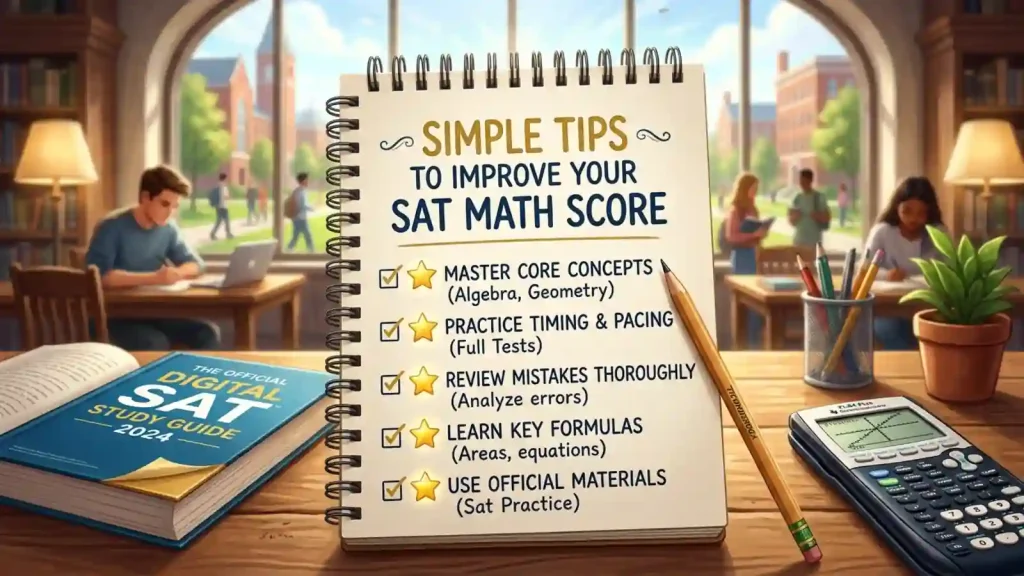
- Learn the formulas by heart. The SAT gives you a formula sheet, but knowing it well saves you time.
- Write down each step. Even easy problems can go wrong if you rush. Writing helps you catch mistakes.
- Practice with a timer. You get about one minute for each question. Timed practice helps you get faster.
- Study your weak spots first.Don’t limit yourself to practicing your existing skills.
- Use guessing smartly. If you are stuck, cross out answers you know are wrong. This makes your guess better.
- Take short breaks. Your brain works better when it is not tired. A short break between practice sessions helps you remember more.
- Talk through hard problems. Saying the steps out loud can help you find where you got stuck.
H3: Mistakes Students Often Make
- Reading word problems too fast and missing key numbers
- Forgetting to check if an answer makes sense
- Skipping practice on the no-calculator part
- Not looking back at wrong answers after a practice test
H2: How to Use This Practice Test the Right Way

- Try to solve each question on your own first.
- Use a timer to copy real test conditions.
- Check each answer, even the ones you got right.
- Write down which topics were hard for you.
- Try a new practice test after a few days.
Conclusion
Doing well on SAT Math is not about being a math genius. It is about practicing the right way. When you solve real questions and check your steps, you learn how the test works. Keep practicing often. Look closely at your mistakes. Your score will go up with steady effort
FAQs
1. How many questions are on the SAT Math test?
There are 58 questions in total. Some allow a calculator, and some do not.
2. Can I use a calculator on the whole SAT Math test?
No. Part of the test does not allow a calculator. The other part does.
3. What is a good SAT Math score?
A score of 650 or higher is strong. A score of 700 or more is great for top schools. It depends on where you want to apply.
4. How can I raise my SAT Math score fast?
Check your wrong answers closely. Learn the key formulas. Practice with a timer often.
5. Are practice tests like the real SAT?
Yes. Good practice tests copy the same style, topics, and difficulty as the real SAT Math test.
Continue reading:
- STAAR Practice Test 2026: Free Practice Questions & Answers by Grade Level
- Free GED Practice Test 2026: Pass Your Exam on the First Try!
- Free PSAT Practice Test: Solve Real Problems & Boost Your Score
