
Getting your real estate license opens the door to a rewarding career, but first, you have to clear one major hurdle: the real estate licensing exam. Many candidates feel overwhelmed by the amount of material, the unfamiliar terminology, and the pressure of a timed test. The good news is that with the right Real Estate Exam Prep strategy, passing on your first attempt is completely achievable.
This guide breaks down everything you need to know, from understanding the exam format to building a study plan that actually works. Whether you’re studying for a national real estate license or a state-specific certification, the core strategies in this guide apply across the board, helping you turn exam anxiety into exam-day confidence.
Why Real Estate Exam Prep Matters
The real estate exam isn’t just a formality. It tests your understanding of property law, contracts, financing, ethics, and state-specific regulations. Walking in unprepared often leads to unnecessary retakes, wasted fees, and delayed career plans.
A structured real estate exam prep plan helps you:
- Identify weak areas before test day
- Build confidence through practice
- Manage time effectively during the exam
- Avoid common traps in tricky question wording
How the Real Estate Exam Is Structured
Most state real estate exams are divided into two main sections.
National Portion
This section covers general real estate principles that apply across the country, including:
- Property ownership and land use
- Contracts and agency relationships
- Financing basics
- Real estate math and calculations
- Fair housing and ethics
State-Specific Portion
This section focuses on the laws and regulations unique to the state where you’re getting licensed, such as licensing requirements, disclosure laws, and local real estate practices.
Tip: Always check your state’s real estate commission website for the exact exam breakdown, since question counts and passing scores vary by state.
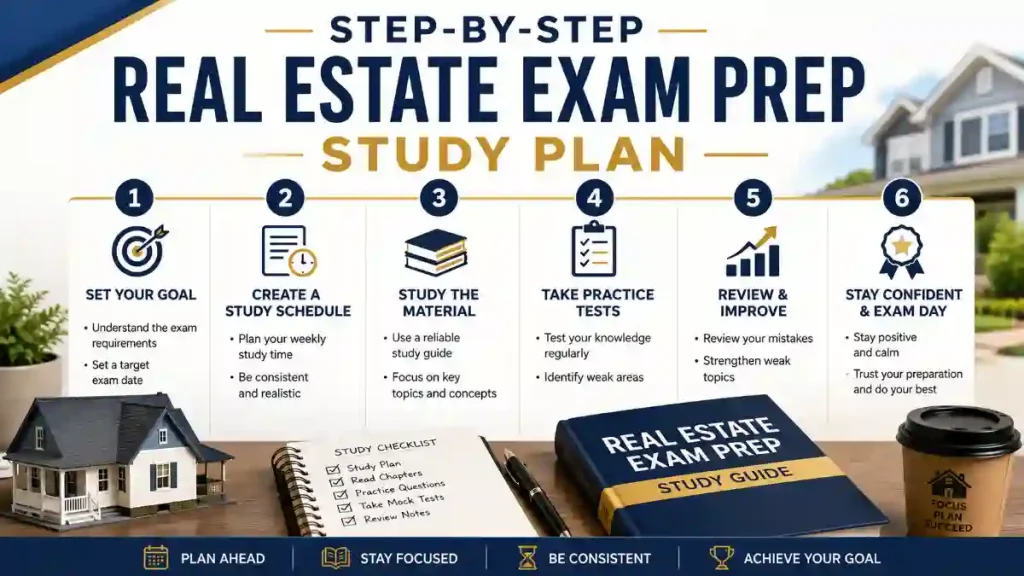
Step-by-Step Real Estate Exam Prep Study Plan
A random study approach rarely works. Follow this structured timeline instead.
| Week | Focus Area | Goal |
| Week 1 | National principles & terminology | Build foundational knowledge |
| Week 2 | Real estate math & contracts | Master calculations and agreements |
| Week 3 | State-specific laws | Learn local licensing rules |
| Week 4 | Practice exams & review | Identify and fix weak areas |
Step 1: Understand the Exam Format First
Before diving into content, review your state’s exam outline. Knowing the number of questions, the time limit, and the passing score helps you realistically plan your Real Estate Exam Prep study pace.
Step 2: Use Active Recall, Not Passive Reading
Simply re-reading notes doesn’t build long-term memory. Instead, use flashcards, practice questions, and self-testing to reinforce key concepts like escrow, easements, and fiduciary duties.
Step 3: Focus Heavily on Real Estate Math
Many candidates lose points here. Practice calculations for:
- Prorations
- Loan-to-value ratios
- Commission splits
- Property tax and appraisal values
Step 4: Take Full-Length Practice Exams
Simulating real exam conditions builds stamina and reduces test-day anxiety. Aim for at least 3–5 full practice tests before your scheduled exam date.
How to Pick the Best Course for Real Estate Exam Preparation
Not every prep course fits every learning style, so it’s worth evaluating a few options before committing your time and money.
What to Look For
- State-specific alignment: Make sure the course covers your exact state’s licensing requirements, not just general national content.
- Practice question volume: A strong course should include hundreds of practice questions, not just a handful.
- Updated content: Real estate laws change periodically, so choose a course updated within the last year.
- Instructor support: Access to instructors or study groups can help clarify confusing topics quickly.
Free vs. Paid Prep Options
Free YouTube tutorials and practice question banks are a good starting point for building familiarity with terminology. However, paid state-approved courses often provide more structured, exam-aligned content and are sometimes required to qualify for the exam in the first place. A balanced approach — using free resources for review and a paid course for core learning — tends to work well for most candidates.
Best Study Materials and Resources
- State-approved pre-licensing course materials
- Real estate exam prep books specific to your state
- Online practice question banks
- Flashcard apps for terminology review
- YouTube channels offering free real estate exam walkthroughs
Common Mistakes to Avoid During Exam Prep
- Cramming last minute instead of spacing out study sessions
- Ignoring state-specific laws and only focusing on national content
- Skipping real estate math practice, which often causes the most point loss
- Not reviewing wrong answers from practice tests to understand mistakes
- Underestimating vocabulary-heavy questions, which require precise term recognition
Test-Day Tips for Real Estate Exam Success
- Before the test, get a good night’s sleep.
- Arrive early to avoid unnecessary stress.
- Read each question twice before answering
- Ignore challenging questions and come back to them later.
- Don’t spend too much time on a single question; instead, manage your time.
- Stay calm if the material feels unfamiliar; most exams include a small number of unusually worded questions by design.n
- Double-check your answer sheet or digital submission before finalizing, especially on math-based questions
How Much Time Does It Take to See Results?
Many computer-based real estate exams provide results immediately after submission, while some states process results within a few business days. Check your testing center’s policy in advance so you know what to expect and can plan your next steps, whether that means celebrating a pass or scheduling a retake.
Conclusion
Passing your real estate exam comes down to consistent, focused preparation rather than last-minute cramming. By understanding the exam structure, following a structured study timeline, practicing real estate math, and taking full-length practice tests, you’ll walk into the exam room with confidence. Choosing the right prep course, avoiding common mistakes, and applying smart test-day strategies all add up to a stronger outcome. Stay consistent with your real estate exam prep plan, and passing on your first try becomes a realistic, achievable goal.
FAQ
1. How much time should I spend studying for the real estate test?
Most candidates need 4–6 weeks of consistent study, depending on their state’s requirements and prior knowledge of real estate concepts.
2. What is the hardest part of the real estate exam?
Real estate math and state-specific laws are typically the most challenging sections for first-time test takers.
3. How many times can I retake the real estate exam if I fail?
This varies by state, but most states allow multiple retakes, often with a waiting period between attempts.
4. Are online real estate exam prep courses effective?
Yes, online courses can be highly effective when paired with practice exams and active recall techniques, especially for self-paced learners.
5. What score do I need to pass the real estate exam?
Passing scores vary by state, but most require around 70–75% correct answers. Always check with the licensing board in your state to find out the precise requirements.
