
NCLEX Study Guide can help new nursing graduates who are starting their NCLEX preparation and unsure where to begin. With so much nursing content, practice questions, and study advice available online, it can be difficult to know where to start. A clear study plan can help you organize your preparation, use your study time effectively, and avoid feeling overwhelmed. This guide will help you understand the basics and prepare for the NCLEX with greater confidence.
What Is the NCLEX Exam? NCLEX Study Guide Basics
The NCLEX, or National Council Licensure Examination, is the licensing exam every nursing graduate in the U.S. and Canada must pass before practicing as a nurse. Two versions exist depending on your program:
- NCLEX-RN – required for Registered Nurses
- NCLEX-PN – required for Practical/Vocational Nurses
The NCLEX isn’t a typical knowledge test. It’s designed to evaluate clinical judgment: how well you can apply nursing knowledge to real patient scenarios and make safe decisions, often under time pressure.
Key Facts About the NCLEX Format
| Feature | Details |
| Exam Type | Computerized Adaptive Test (CAT) |
| Question Range | 85–150 (NCLEX-RN), 85–205 (NCLEX-PN) |
| Time Limit | Up to 5 hours |
| Passing Standard | Based on the Next Generation NCLEX (NGN) model |
| Question Types | Multiple choice, select-all-that-apply, drag-and-drop, case studies, bowtie/trend items |
Since the exam is computer-adaptive, each question’s difficulty adjusts based on how you’ve answered previous ones. This means memorized answer patterns won’t help; the test is built around genuine understanding, not repetition.
Why a Study Guide Matters for Beginners
One of the most common mistakes beginners make is jumping into practice questions without a clear plan. A structured NCLEX Study Guide can help you organize your preparation, focus on important topics, and make better use of your study time.
- Know exactly what the exam is testing
- Set an actually realist goalic
- Direct your effort toward high-yield nursing content
- Measure progress instead of studying without a clear target
Without this kind of structure, it’s easy to over-study familiar topics while neglecting the ones that actually need work.
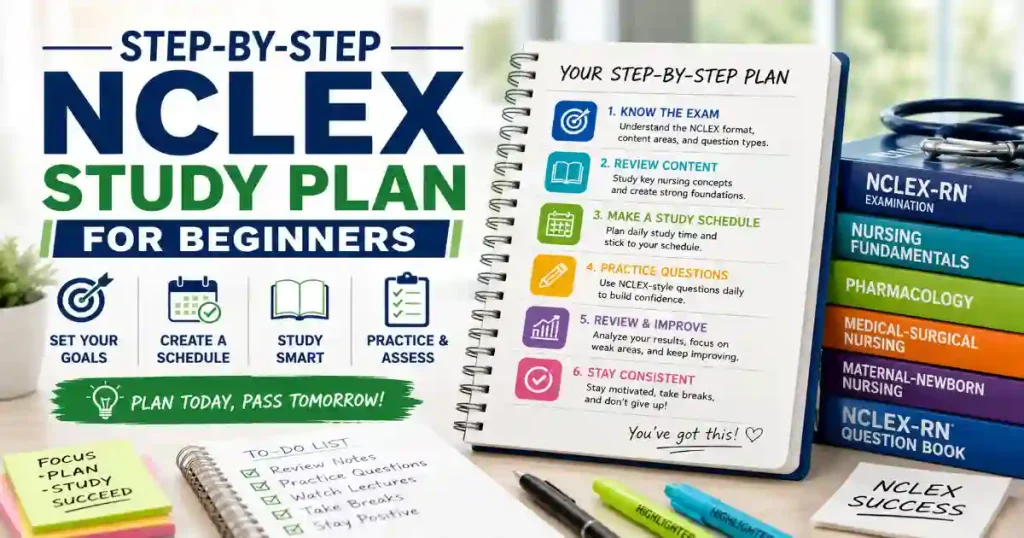
Step-by-Step NCLEX Study Plan for Beginners
Step 1: Understand the NCLEX Test Plan
Before opening a question bank, get familiar with the official NCLEX test plan. It organizes all exam content into four major categories:
- Safe and Effective Care Environment
- Health Promotion and Maintenance
- Psychosocial Integrity
- Physiological Integrity
This breakdown in the NCLEX Study Guide helps you study topic by topic rather than jumping randomly between subjects, making your preparation more organized and efficient.
Step 2: Build a Study Schedule You Can Actually Follow
A 4–8 week timeline works well for most beginners, depending on daily availability.
Sample Weekly Structure:
- Monday–Friday: 2–3 hours of content review with 30–50 practice questions
- Saturday: A full-length practice quiz followed by reviewing every incorrect answer
- Sunday: Light review, or a complete rest day
Short, consistent sessions almost always outperform occasional marathon study days.
Step 3: Practice Active Recall, Not Passive Reading
Re-reading notes or highlighting textbooks feels productive but rarely prepares you for the NCLEX’s reasoning-heavy format. Instead, use your NCLEX Study Guide to focus on active learning, practice questions, and understanding why each answer is correct.
- Answer practice questions daily, even in short batches
- Read the rationale for every question, correct or incorrect
- Return to missed questions a few days later to test retention
Why Rationales Matter
The NCLEX rewards reasoning, not memorized answers. Understanding why one choice is correct nd why the others aren’t what actually builds clinical judgment. Skipping this step is one of the most common reasons beginners plateau.
Step 4: Prioritize High-Yield Topics
Certain subjects show up more often and carry more weight on exam day. Beginners get the best return by focusing on:
- Pharmacology and medication safety
- Fluid and electrolyte balance
- Cardiac and respiratory disorders
- Prioritization and delegation
- Infection control
Spending extra time here tends to pay off far more than reviewing every topic equally.
Free NCLEX Study Resources Worth Using
Solid NCLEX prep doesn’t require a paid subscription. Some genuinely helpful free options include:
- NCSBN’s official practice resources – for an accurate feel of exam format
- YouTube nursing education channels – for clear, visual breakdowns of tricky concepts
- Free mobile apps with question banks – convenient for daily practice anywhere
- Nursing student forums and study groups – for shared notes and peer motivation
- State board of nursing websites – for current, accurate licensure requirements
Using two or three of these together usually works better than relying on just one.
Common Mistakes Beginners Should Avoid
- Giving every topic equal study time instead of prioritizing high-yield areas
- Memorizing answers without understanding the underlying reasoning
- Skipping rationale review after practice sessions
- Never practicing under timed, exam-like conditions
- Losing track of pacing during practice questions
Catching these habits early can save weeks of inefficient studying down the line.
How to Determine Your NCLEX Readiness
A reliable sign of readiness is consistently scoring above the recommended benchmark on full-length practice exams, with genuine confidence in prioritization and clinical judgment questions, not just recall-based ones. Your NCLEX Study Guide should help you track these practice results and identify areas that still need improvement. Readiness isn’t about perfect scores; it’s about steady, dependable performance across every content area.
Conclusion
NCLEX prep doesn’t have to feel overwhelming or directionless. With a clear study plan, focus on high-yield content, consistent daily practice, and a handful of solid free resources, beginners can walk into exam day with real, earned confidence. NCLEX Study Guide can give you a practical starting point and help you stay organized throughout your preparation. Start early, stay consistent, and trust the process.
(FAQs)
1. Can I pass the NCLEX using only free resources?
Yes. Many nursing graduates pass relying entirely on free resources, especially when paired with daily practice and consistent rationale review.
2. How many hours a day should a beginner study for the NCLEX?
Most beginners do best with 2–3 focused hours daily rather than infrequent, long sessions. Regular practice matters more than total hours logged.
3. What’s the best way to begin NCLEX prep as a complete beginner?
Start by reviewing the official NCLEX test plan and format, then move into practice questions paired with detailed rationale review.
4. How long does NCLEX preparation usually take?
Timelines vary by individual, but most beginners need around 4–8 weeks, depending on their nursing school background and daily availability.
5. Do I need to memorize lab values and dosage calculations for the NCLEX?
Yes. Familiarity with normal lab value ranges and basic dosage calculations is important, as these appear frequently in physiological integrity questions.
