

This TEAS study guide is built for anyone applying to a nursing or allied health program who wants to pass the exam on the first attempt. If you’ve already heard how much the TEAS exam can affect your admission chances, you’re not alone; most nursing applicants feel the same pressure. The good news is that with the right study plan and a clear understanding of what the exam actually tests, you don’t need to take it more than once.
This guide breaks down exactly what the TEAS exam covers, how to prepare for it, and the study strategies that actually help students pass on their first attempt.
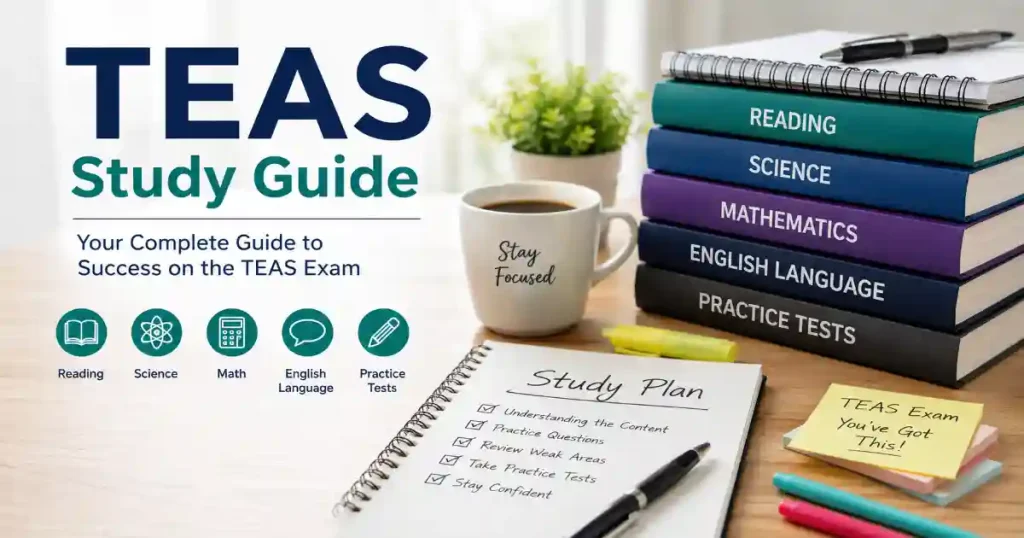
What Is the TEAS Exam? (Why a TEAS Study Guide Matters)
The TEAS (Test of Essential Academic Skills) is a standardized exam used by nursing and allied health programs to evaluate whether applicants are ready for the academic demands of their coursework. It’s developed by ATI (Assessment Technologies Institute) and is often referred to as the ATI TEAS exam.
Most nursing schools require a minimum TEAS score as part of their admission process, which makes proper preparation essential t optional.
Why Nursing Schools Use the TEAS Exam
- It predicts how well a student will perform in nursing coursework
- It ensures applicants have basic academic skills in math, science, reading, and English
- It helps schools compare applicants fairly using one standardized measure
Who Needs to Take the TEAS Exam?
Anyone applying to an accredited nursing program (RN, LPN/LVN) or many allied health programs such as radiology tech or respiratory therapy is typically required to take the TEAS exam as part of the admissions process. That’s exactly why having a reliable TEAS study guide before test day makes such a big difference.
TEAS Exam Sections Explained
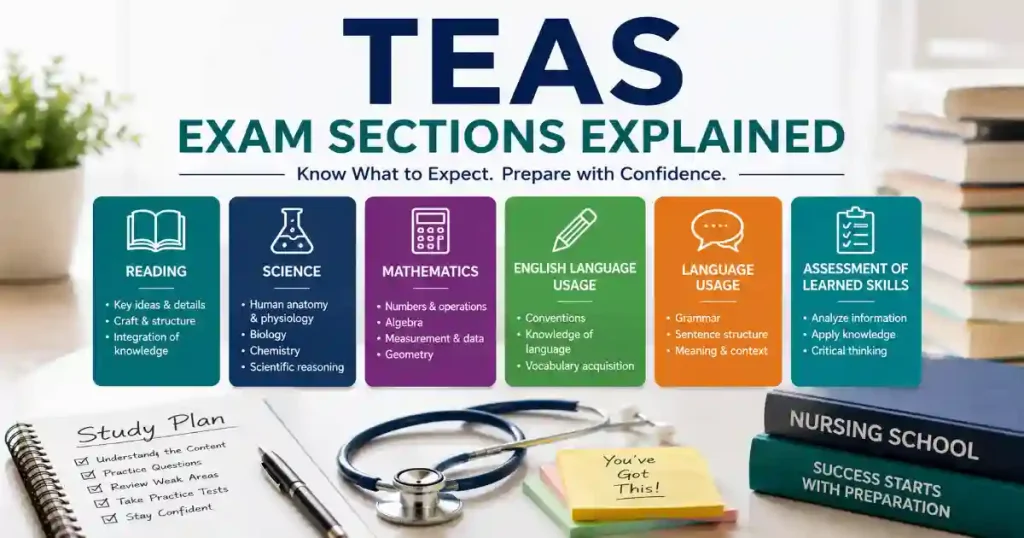
There are four primary portions of the TEAS exam. Understanding what each section tests is the first step toward building an effective study plan.
| Section | What It Tests | Approx. Questions | Time Limit |
| Reading | Comprehension, inference, information analysis | 45 | 55 minutes |
| Math | Algebra, measurement, data interpretation | 38 | 57 minutes |
| Science | Anatomy, biology, chemistry, scientific reasoning | 50 | 60 minutes |
| English & Language Usage | Grammar, vocabulary, sentence structure | 37 | 28 minutes |
Reading Section
This portion assesses your comprehension of written texts, graphs, and charts. You’ll need to identify main ideas, draw conclusions, and interpret information quickly.
Key Reading Skills to Practice
- Identifying the main idea vs. supporting details
- Making logical inferences from a passage
- Interpreting graphs, charts, and diagrams
Math Section
Expect questions on basic algebra, ratios, conversions, and reading data from tables and graphs. A calculator is provided within the testing platform, so memorizing complex formulas isn’t necessary, but understanding when to use them is. A good TEAS study guide will always emphasize practice over memorization for this section.
Common Math Topics on the TEAS
- Ratios, proportions, and percentages
- Basic algebraic equations
- Metric conversions
- Reading data tables and graphs
Science Section
For the majority of test takers, this is usually the most difficult section. It covers human anatomy and physiology, basic biology, chemistry, and scientific reasoning.
Core Science Topics to Review
- Anatomy and physiology of humans (all major body systems)
- Basic biology (cells, genetics)
- Basic chemistry (atoms, reactions, the periodic table)
- Scientific reasoning and the scientific method
English and Language Usage Section
This section checks your grasp of grammar rules, punctuation, sentence structure, and vocabulary skills you’ll rely on heavily in nursing documentation and coursework.
How Much Time Should You Spend Studying for the TEAS Exam?
There’s no single answer that fits everyone, but most successful test-takers study for 4 to 6 weeks, dedicating around 1–2 hours daily. Your ideal timeline for this TEAS study guide depends on how comfortable you already are with math and science concepts.
A Simple 4-Week TEAS Study Plan
Week 1 — Diagnose and Plan
- Take a lengthy practice exam to find your weak points.
- Organize a study schedule based on your results
- Focus extra time on Science if it’s your weakest subject
Week 2 — Build Core Knowledge
- Review Reading comprehension strategies
- Study Math formulas and practice problems daily
- Begin reviewing anatomy and physiology basics
Week 3 — Strengthen Weak Areas
- Take a second practice test
- Focus heavily on whichever section scored lowest
- Practice English grammar rules with quick daily drills
Week 4 — Final Review and Practice
- Take one more full-length timed practice test
- Examine all of the wrong responses and determine why you missed them.
- Rest the day before your exam; avoid last-minute cramming
Best TEAS Study Tips and Free Resources
Studying intelligently is more important than studying for a long time. These tips will help you prepare more efficiently.
- Take practice tests under timed conditions.
- This increases endurance and lessens worry on test day.
- Focus on weak areas first
- Don’t waste time re-studying what you already know well
- Use flashcards for Science terms
- Anatomy and biology vocabulary is easier to retain in small daily doses
- Review your mistakes, not just your scores
- Recognising the reasons behind an incorrect response helps avoid making the same mistakes twice.
- Join a TEAS study group
- Giving explanations of ideas to others helps you understand them better.
- Use official ATI study materials
- They most closely match the real exam format and difficulty
- Sleep well before the exam
Your ability to think clearly declines when you don’t get enough sleep.
What to Watch Out For
Common Mistakes to Avoid
- Cramming everything in the final 2–3 days instead of spacing out study sessions
- Ignoring the Science portion till the very end
- Skipping timed practice tests and only reviewing notes passively
- Not reviewing why an answer was wrong before moving on
TEAS Passing Score and What Happens After
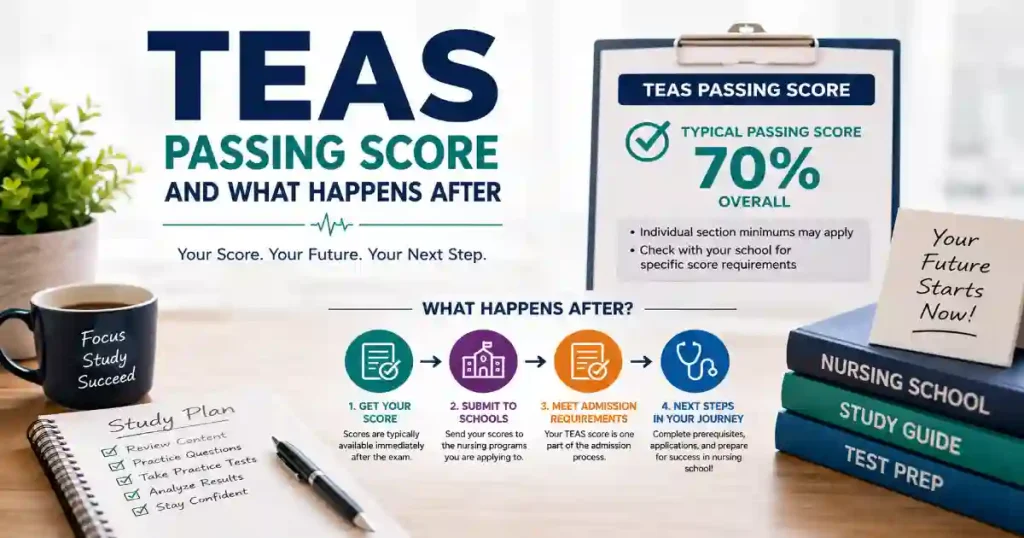
Every nursing program determines its own “passing score” for the TEAS exam. Minimum requirement. However, ATI generally categorizes scores as follows:
| Score Range | Proficiency Level |
| 90% and above | Advanced |
| 78%–89% | Proficient |
| 58%–77% | Basic |
| Below 58% | Below Basic |
Most competitive nursing programs look for scores in the Proficient to Advanced range, though requirements vary by school.
What If You Don’t Pass on Your First Attempt?
If your score doesn’t meet your target program’s requirement, most schools allow retakes after a required waiting period (often 30–60 days). Use that time to focus specifically on your weakest section rather than repeating a full general review.
Conclusion
Following a solid TEAS study guide and passing the TEAS exam on your first attempt comes down to understanding the exam structure, building a realistic study schedule, and focusing your energy on the areas that need the most improvement. With consistent daily practice over 4–6 weeks, most students can walk into test day feeling prepared and confident without needing a second attempt.
(FAQs)
1. How long does it take to study for the TEAS exam?
Most students need 4 to 6 weeks of consistent daily study to feel fully prepared, though this can vary based on your existing knowledge in math and science.
2. What is the hardest section of the TEAS exam?
The Science section is generally considered the most challenging, since it covers anatomy, physiology, and chemistry topics that many students haven’t reviewed recently. Any solid TEAS study guide will recommend spending extra time on this section.
3. Can I use a calculator during the TEAS exam?
Yes, a basic calculator is built into the testing platform for the Math section, so you don’t need to bring your own.
4. How many times can I retake the TEAS exam?
This depends on your nursing program and testing center policy, but most allow retakes after a waiting period, commonly between 30 and 60 days.
5. Is the TEAS exam the same for every nursing school?
The exam content is standardized by ATI, but each nursing program sets its own required minimum score, so requirements can vary between schools.
