
Preparing for the HESI exam can feel difficult when you are not sure what to study or how to organize your time. A clear study plan can help you focus on the right subjects, improve weak areas, and prepare with greater confidence.
This HESI Study Guide explains what to study, how to create a simple study plan, how to use practice questions, and how to avoid common preparation mistakes.
What Is the HESI Exam?
“The HESI Admission Assessment, commonly called the HESI A2, is an exam used by many nursing and healthcare programs to evaluate students’ academic skills and knowledge. This HESI Study Guide will help you understand what to expect and how to prepare.”
The sections required can vary by school. Common HESI A2 subjects include:
- Mathematics
- Reading Comprehension
- Vocabulary
- Grammar
- Biology
- Chemistry
- Anatomy and Physiology
Before you start studying, check your school’s requirements. This helps you focus on the sections you actually need to complete.
How to Start Preparing for the HESI
Start by finding out your current strengths and weaknesses. Taking a practice test before your main preparation can help you understand which subjects need the most attention.
Divide your subjects into three groups:
| Level | Meaning | Priority |
| Strong | You answer most questions correctly | Low |
| Average | You understand the basics | Medium |
| Weak | You regularly struggle | High |
Spend more study time on weak subjects while continuing to review the areas you already understand.
Create a HESI Study Plan
A study plan makes preparation more organized. Instead of studying random topics each day, give every session a specific goal.
| Day | Subject | Activity |
| Monday | Math | Review and practice |
| Tuesday | Reading | Practice passages |
| Wednesday | Vocabulary & Grammar | Review and questions |
| Thursday | Anatomy & Physiology | Topic review |
| Friday | Biology & Chemistry | Practice questions |
| Saturday | Mixed Subjects | Practice test |
| Sunday | Weak Areas | Review mistakes |
Adjust the schedule according to your exam date and required sections.
HESI Math Preparation
Focus on the basic math skills that frequently appear in HESI preparation materials.
Important topics include:
- Fractions
- Decimals
- Percentages
- Ratios
- Proportions
- Basic calculations
- Conversions
- Word problems
“According to this HESI Study Guide, practice is more useful than simply reading math notes. After every incorrect answer, identify what caused the mistake and practice a similar problem.”
HESI Reading Comprehension Preparation
Reading questions test how well you understand information in a passage.
Practice:
- Finding the main idea
- Identifying supporting details
- Understanding words in context
- Making inferences
- Finding logical conclusions
- Understanding the author’s purpose
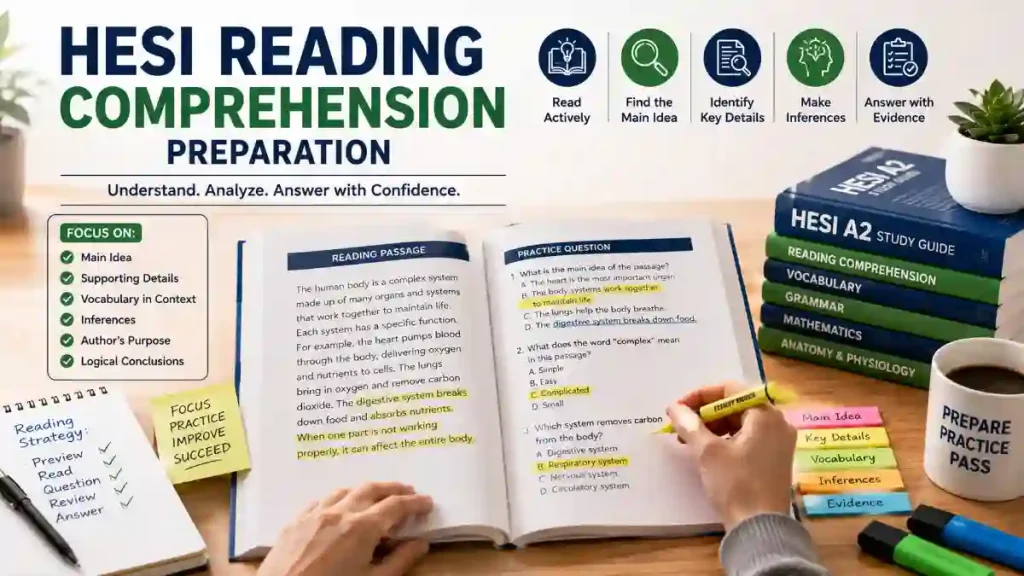
Read the passage carefully and choose the answer supported by the information provided. Avoid selecting an answer simply because it sounds reasonable.
HESI Vocabulary and Grammar Preparation
For vocabulary, study a small number of words regularly instead of trying to memorize a large list at once.
For each word, learn its:
- Meaning
- Synonym
- Example sentence
For grammar, review subject-verb agreement, parts of speech, pronouns, verbs, sentence structure, and punctuation.
When you make a mistake, learn the rule behind the answer instead of memorizing the answer itself.
HESI Anatomy and Physiology Preparation
Anatomy and Physiology can be challenging because you need to understand many structures and functions.
Focus on major body systems such as:
- Cardiovascular system
- Respiratory system
- Nervous system
- Digestive system
- Skeletal system
- Muscular system
- Endocrine system
- Urinary system
Use active recall to improve your memory. Close your notes and explain what an organ does or how a body system works. Then check your answer and review anything you missed.
HESI Biology and Chemistry Preparation
“For Biology, this HESI Study Guide recommends reviewing basic concepts such as cells, biological molecules, metabolism, genetics, cellular respiration, and photosynthesis.”
For Chemistry, focus on matter, atoms, elements, the periodic table, chemical reactions, equations, and bonding.
Break difficult topics into smaller sections. After reviewing a topic, answer practice questions to see whether you actually understand it.
How to Use HESI Practice Tests
“Practice tests can help you become familiar with questions and identify weak areas, as this HESI Study Guide explains. However, taking a test without reviewing your mistakes limits its value.”
After each practice test:
- Check your answers.
- Mark incorrect questions.
- Find out why you made each mistake.
- Review the related topic.
- Practice similar questions.
Also review questions you answered correctly by guessing. These may show areas where your understanding is still weak.
Common HESI Study Mistakes
Studying Without a Plan
Random studying can waste time. Create a schedule and set a specific goal for each session.
Focusing Only on Easy Topics
Do not spend most of your time reviewing material you already understand. Give more attention to weak areas.
Only Reading Notes
Reading notes repeatedly does not always show whether you can answer questions independently. Use practice questions and active recall.
Ignoring Wrong Answers
Wrong answers show you exactly where improvement is needed. Examine things thoroughly rather than proceeding right away.
Cramming Before the Exam
Trying to learn everything the night before can increase stress. Spread your preparation across multiple days or weeks.
How to Know You Are Ready for the HESI
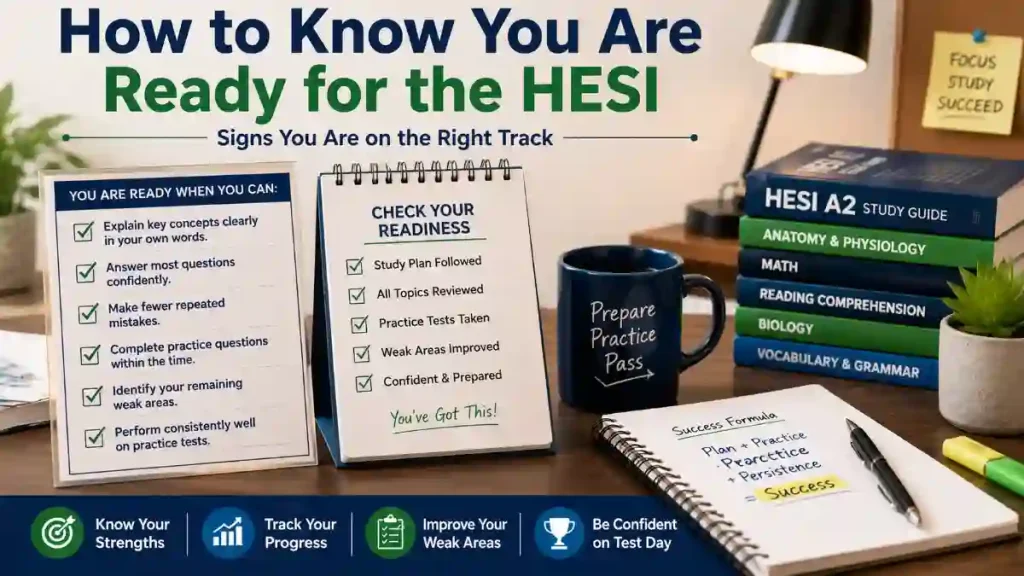
You are making good progress when your practice scores improve consistently and you can answer questions without constantly checking your notes.
You should also be able to:
- Explain important concepts in your own words.
- Make fewer repeated mistakes.
- Complete practice questions within the available time.
- Identify your remaining weak areas.
- Perform consistently on practice tests.
HESI Test-Day Tips
Get enough sleep before the exam and avoid heavy last-minute studying.
Before test day:
- Check your school’s requirements.
- Prepare necessary materials.
- Arrive on time.
- Review important concepts briefly.
- Stay calm.
During the exam, read each question carefully. If you are unsure, eliminate clearly incorrect options and choose the answer that best fits the question.
Conclusion
A successful HESI Study Guide strategy starts with knowing which sections your school requires. Take a practice test, identify your weak areas, and create a realistic study schedule.
Focus on the subjects you need, practice regularly, and review your mistakes. Instead of trying to memorize everything at once, break your preparation into smaller daily sessions.
Consistent preparation can help you improve your knowledge, reduce test-day stress, and approach the HESI exam with greater confidence.
FAQs
What should I study first for the HESI?
Start with the sections required by your school. Take a practice test to identify your weakest subjects and focus on those areas first.
How long should I study for the HESI?
It depends on your current knowledge, exam date, and required sections. Give yourself enough time to review weak areas and complete practice tests.
What subjects are on the HESI A2?
Common sections include Math, Reading Comprehension, Vocabulary, Grammar, Biology, Chemistry, and Anatomy and Physiology. Requirements can vary by school.
Are HESI practice tests helpful?
Yes. They can help you identify weak areas, practice answering questions, and measure your progress. Reviewing incorrect answers is especially important.
How can I improve my HESI score?
Focus on weak subjects, practice consistently, review your mistakes, and use active recall. A structured study routine is more useful than last-minute cramming.
