
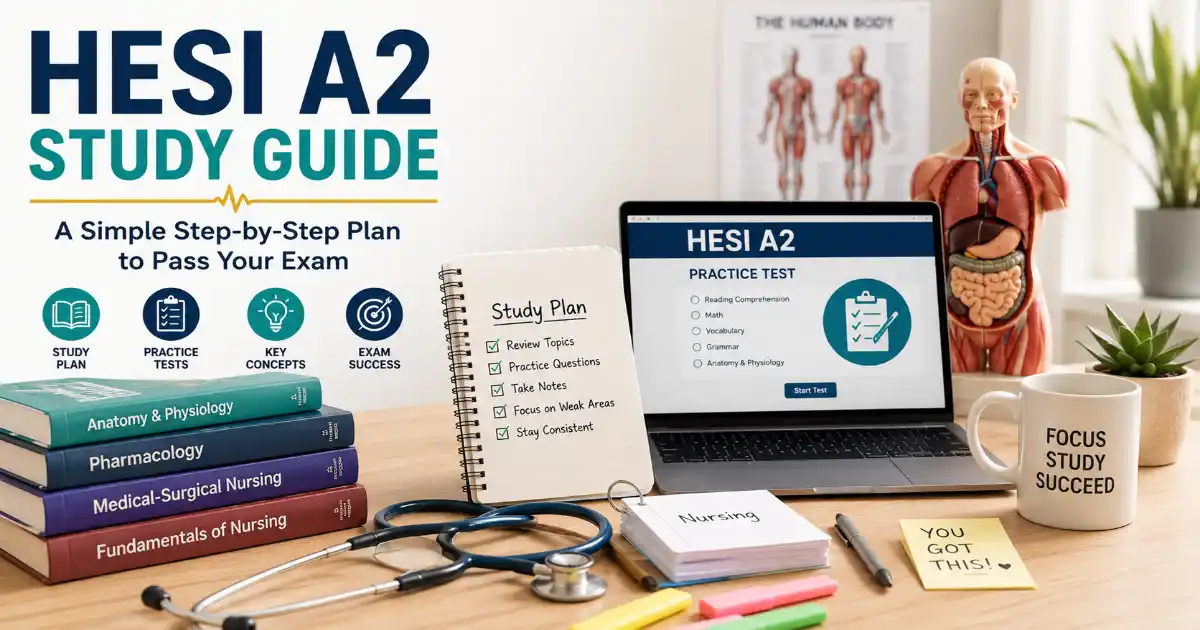
Getting into a nursing program often starts with one major hurdle: the HESI A2 exam. For many students, this test feels overwhelming because it covers several subjects at oncemath, reading, science, and grammarall in a single sitting. The good news is that with the right plan and a reliable HESI A2 Study Guide, the exam becomes much easier to manage.
This HESI A2 Study Guide breaks the process down into simple, practical steps so you know exactly what to study, how to study it, and how to walk into your test day feeling prepared instead of anxious.

What Is the HESI A2 Exam?
The HESI A2 (Health Education Systems Inc.Nursing and allied health programs nationwide use the Admission Assessment exam as a standardised entry exam. Schools use HESI A2 scores to evaluate whether an applicant is academically ready for the demands of a nursing curriculum.
Unlike a single-subject test, the HESI A2 exam checks a wide range of skills at once. This is exactly why a structured study plan matters more here than it does for many other exams.
Why Schools Use the HESI A2 Exam
- It predicts academic readiness for nursing coursework
- It measures both knowledge and personality traits related to learning style
- It gives admissions committees an objective way to compare applicants
- It helps identify students who may need extra academic support early on
HESI A2 Exam Sections Explained
Not every nursing program requires the same sections, so it’s important to check with your specific school. However, most HESI A2 exams include the following core areas.
1. Math
This section tests basic arithmetic, fractions, ratios, percentages, military time, and dosage calculations. Most HESI A2 Study Guide resources include extensive practice questions in these areas because nurses calculate medication dosages daily, making this section especially important in real-world healthcare settings.
2. Reading Comprehension
You’ll be asked to read short passages and answer questions about main ideas, inference, and supporting details. Speed and accuracy both matter here.
3. Vocabulary and General Knowledge
This section checks your understanding of medical and general terminology commonly used in healthcare settings.
4. Grammar
Expect questions on sentence structure, parts of speech, and correct word usage.
5. Science
This is usually the most detailed section and can include several sub-topics, each tested on its own.
Anatomy and Physiology
Covers body systems, organ functions, and how different systems work together.
Biology
Focuses on cell structure, genetics, and basic life processes.
Chemistry
Includes basic chemical reactions, the periodic table, and lab-related concepts.
Physics (in Some Versions)
Some schools include basic physics concepts such as motion, force, and energy.
Personality and Learning Style Profile in a HESI A2 Study Guide
Some versions include a personality and learning-style assessment. A HESI A2 Study Guide can help you understand what to expect from this section. Although it isn’t scored for pass/fail purposes, it helps schools understand how you learn best
HESI A2 Test Structure at a Glance
| Section | What It Covers | Typical Focus |
| Math | Fractions, ratios, dosage calculation | Accuracy under time pressure |
| Reading Comprehension | Passage-based questions | Main idea, inference |
| Vocabulary | Medical and general terms | Word meaning in context |
| Grammar | Sentence structure, usage | Correct grammar application |
| Science | A&P, biology, chemistry | Conceptual understanding |
Note: Exact sections and question counts vary by school, so always confirm requirements with your program before planning your study schedule.
Step-by-Step Plan to Study for the HESI A2 Exam
Step 1: Confirm Your School’s Exact Requirements
Before diving into a HESI A2 Study Guide, contact your nursing program to confirm which sections you’ll be tested on and their minimum passing score. This simple step can save weeks of unnecessary studying and help you focus on the right material.
Step 2: Take a Diagnostic Practice Test First
Don’t start by memorizing content. Instead, take a full-length practice test to see where you currently stand. This indicates which areas require the greatest care.
Step 3: Build a Realistic Study Schedule
A study plan works only if it’s realistic. Break your prep into weekly blocks based on your test date.

Sample 4-Week HESI A2 Study Schedule
- Week 1: Math fundamentals and dosage calculations
- Week 2: Reading comprehension and vocabulary
- Week 3: Grammar rules and anatomy & physiology
- Week 4: Full practice tests, weak-area review, and light revision
Step 4: Focus on Weak Areas First
It’s tempting to review what you already know because it feels productive. Instead, spend more time on sections where your diagnostic test showed lower scores.
Step 5: Practice With Timed Sections
The HESI A2 exam is timed, so studying without a timer only gives you half the picture. Practice answering questions under real exam-like conditions to build speed and reduce test-day anxiety.
Step 6: Review Mistakes, Not Just Answers
After every practice quiz, don’t just check right or wrong. Understand why an answer was wrong so you don’t repeat the same mistake pattern.
Step 7: Do a Final Review Week
In your last week, avoid learning new material. Focus on:
- Reviewing flagged weak areas
- Taking one final full-length practice test
- Getting adequate sleep before test day
Study Tips That Actually Help
General Study Habits
- Study in short, focused sessions (45–60 minutes) instead of long, tiring blocks
- Use flashcards for vocabulary and anatomy terms
- Avoid cramming the night before light review only
Subject-Specific Tips
Math and Dosage Calculation
Practice dosage calculation problems daily, even just 10 minutes, since this skill improves mainly through repetition.
Reading and Vocabulary
Read short science or health articles daily to build comprehension speed and pick up medical terminology naturally.
Common Mistakes Students Make Before the HESI A2 Exam
Planning Mistakes
- Skipping the diagnostic test and studying blindly
- Studying only the night before instead of building a plan
- Forgetting to confirm which sections their specific school requires
Preparation Mistakes
- Ignoring grammar because it feels “easy”
- Not practicing under timed conditions
HESI A2 Exam Day Tips
Before the Exam
- Get a full night’s sleep before the exam
- Eat a light, balanced meal beforehand
- Arrive early to reduce stress

During the Exam
- Read each question fully before answering
- Don’t dwell too long on one difficult question mark it and move on if allowed
Conclusion
The HESI A2 exam can feel intimidating simply because it covers so much ground at once. But with a clear plan, confirming requirements, taking a diagnostic test, building a realistic study schedule, and focusing on weak areas, it becomes a manageable, structured process rather than a source of stress. Consistency matters more than cramming. A few focused weeks of smart preparation can make the difference between a passing score and having to retake the exam. This HESI A2 Study Guide provides a practical roadmap to help you stay organized, study effectively, and walk into exam day with confidence. By using this HESI A2 Study Guide, you can maximize your preparation and improve your chances of success.
(FAQs)
1. How long should I study for the HESI A2 exam?
Most students prepare for 3 to 6 weeks, depending on how comfortable they already are with math, science, and reading comprehension.
2. What is a good score on the HESI A2 exam?
Passing scores vary by nursing program, but many schools look for an overall score of 75% or higher. Always confirm the exact requirement with your school.
3. Can I retake the HESI A2 exam if I fail?
Yes, most programs allow retakes, though there is often a waiting period between attempts. Check your school’s specific retake policy.
4. Is the HESI A2 exam hard?
It isn’t necessarily hard, but it is broad. The difficulty usually comes from covering multiple subjects in one sitting rather than any single topic being overly complex.
5. Do all nursing schools require the same HESI A2 sections?
No. Requirements vary by school, so it’s important to confirm exactly which sections and minimum scores your program requires before you start studying.
