
The Fundamentals of Engineering Exam is known as the FE Exam. This FE Exam Study Guide will help you understand the test, prepare for it, and take the right steps toward becoming a licensed engineer in the United States. The FE Exam is a major test for many engineering students and is often the first step toward engineering licensure. NCEES runs the exam.
Many students feel scared of this test. But the truth is, the test is not too hard if you study the right way. This guide will explain what the FE Exam is, what topics it covers, and how to create a good study plan. If you follow the steps in this guide, you will feel more ready and less worried on exam day.
What Is the FE Exam?
The FE Exam is a computer test. You take it on a computer at a testing center. It is made for students who are finishing their engineering degree or just graduated. The test checks whether you understand the basic concepts of engineering. It does not test everything you learned in school. It tests the core ideas that every engineer should know.
Quick Facts About the FE Exam
- Type of test: Computer-based, multiple choice
- Time: About 6 hours, with breaks
- Number of questions: 110 questions
- Subjects: Civil, Mechanical, Electrical, Chemical, Industrial, Environmental, and more
- Help book: You get a digital handbook during the test called the NCEES FE Reference Handbook
Why the FE Exam Matters
Passing the FE Exam is an important first step toward becoming a Professional Engineer, also called a PE. This FE Exam Study Guide can help you understand what to expect and how to prepare. After you pass the FE Exam, you may need to gain engineering experience under a licensed engineer before taking the PE Exam. Many employers also value engineers who have passed the FE Exam because it shows a strong understanding of basic engineering concepts.
Who Should Take the FE Exam?
- Final-year engineering students
- New graduates who want to become a licensed engineer
- Engineers who did not take the test earlier in their career
Taking the exam early, right after finishing school, is often easier. This is because the topics are still fresh in your mind from your classes.
What Topics Are Covered in the FE Exam Study Guide?
Select 90 more words to run Humanizer.
Each type of engineering has its own list of topics. But many subjects are the same for everyone. Here is a simple table:
| Subject | Who Studies This |
| Math and Statistics | All students |
| Ethics and Work Rules | All students |
| Engineering Economics | All students |
| Statics and Dynamics | Civil, Mechanical |
| Heat and Energy (Thermodynamics) | Mechanical, Chemical |
| Circuits | Electrical |
| Fluids | Civil, Mechanical, Environmental |
Check Your Own Topic List
Before you study, check the NCEES website for the exact topic list for your subject. Every discipline has a different number of questions from each topic. This helps you know what to study first and what to skip. Spending time on topics that have very few questions is not a good use of your study time.
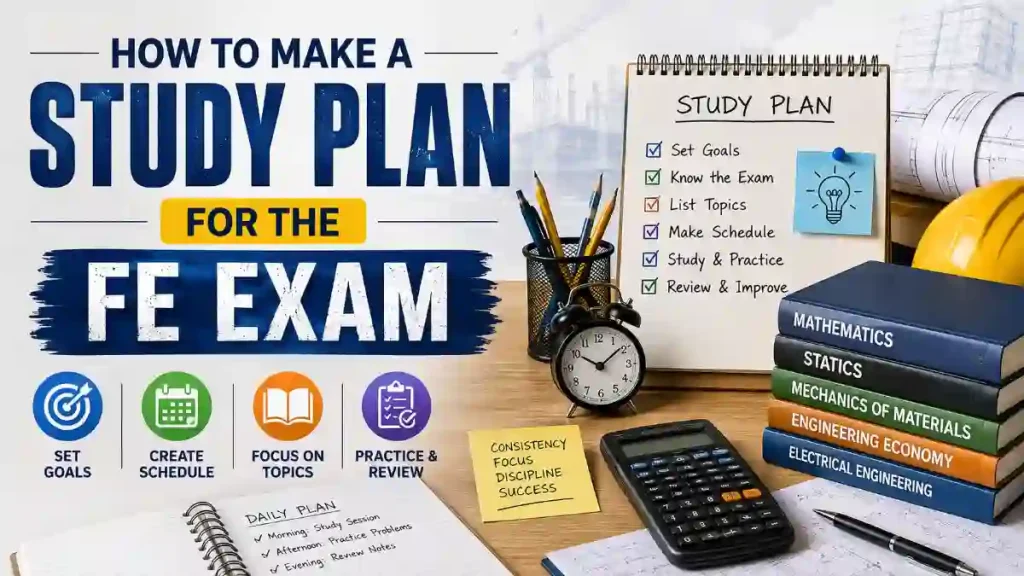
How to Make a Study Plan for the FE Exam
A good plan helps you pass the first time. Here is how to build one.
Step 1: Take a Practice Test First
Before you study anything, take one practice test as part of your FE Exam Study Guide plan. This will show you which topics you already know and which ones need more work. Don’t skip this step because it can save you a lot of study time later. Many students spend too much time reviewing topics they already understand while giving less attention to their weaker areas.
Step 2: Make a Weekly Study Schedule
The majority of students spend eight to twelve weeks studying. They study about 10 to 15 hours each week. Here is a simple plan:
- Weeks 1-6: Study each topic one at a time
- Weeks 7-9: Practice problems, focus on hard topics
- Weeks 10-11: Take full practice tests with a timer
- Week 12: Rest and do light review
Having a written schedule, even a simple one, helps you stay on track. It also makes it easy to see if you are falling behind and need to adjust.
Step 3: Learn the Handbook Well
The handbook is an important part of your FE Exam Study Guide preparation because it is available during the real test. Practice using it before exam day and learn how to search it quickly with Ctrl+F on your keyboard. This can save valuable time during the exam. Knowing where information is located in the handbook is just as important as understanding the topics. Practice with the handbook often so you can find formulas and key information quickly.
Step 4: Take Full Practice Tests With a Timer
Practice tests help you get used to the real test. Try to take at least two full practice tests before your real exam day. Time yourself just like the real test so you know how fast you need to work. This also helps build your focus, since sitting for a long test can be tiring if you are not used to it.
Tips to Pass the FE Exam the First Time
- Answer easy questions first. Ignore difficult ones and return at a later time.
- Don’t think too long on one question. Most questions take only 2-3 minutes.
- If you don’t know an answer, remove the wrong choices first.
- Learn your formula sheet before test day.
- Sleep well the night before. It is more difficult to think when you are exhausted.
Mistakes Students Make on the FE Exam
- Studying every topic the same amount, instead of focusing on weak spots
- Not taking timed practice tests
- Trying to memorize instead of understanding
- Not checking the real topic list for their subject
Your final score can be significantly impacted by avoiding these easy errors. Most of these mistakes happen not because students don’t work hard, but because they don’t plan their study time well.
Conclusion
Passing the FE Exam the first time is about good planning, not luck. This FE Exam Study Guide can help you prepare with a clear plan. Start with a practice test, make a study schedule for 8 to 12 weeks, and learn the handbook well. Take timed practice tests to improve your speed and confidence. If you follow these steps, you can feel more prepared on exam day.
FAQs
1. How long should I study for the FE Exam?
For eight to twelve weeks, most students study. They study about 10 to 15 hours each week.
2. What is the passing score for the FE Exam?
NCEES does not share one fixed passing score. The score changes based on how hard the test is each time.
3. Can I take the FE Exam again if I fail?
Yes. You can retake the exam. But NCEES has rules on how many times you can take it each year.
4. Is the FE Exam hard?
The test is not easy, but it is not impossible. Most people who fail did not manage their time well, not because the topics were too hard.
5. Do I need a calculator for the FE Exam?
Yes, but only certain calculators are allowed for the FE Exam. As part of your FE Exam Study Guide preparation, check the NCEES website for the approved calculator list before test day. This helps you avoid bringing a calculator that is not allowed.
